
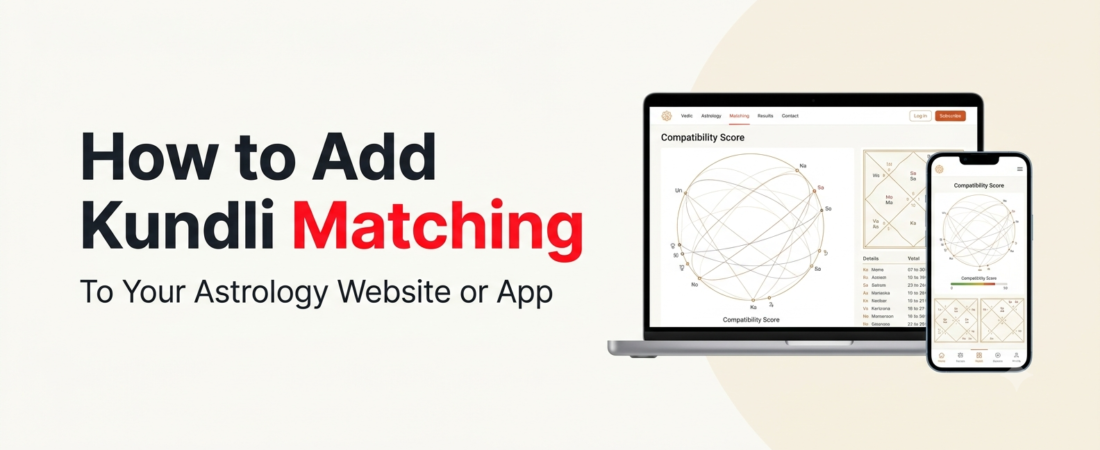
Kundli matching is an important feature for astrology platforms that offer marriage compatibility services. By allowing users to enter their birth details and view a compatibility report, an astrology website or app can provide a more complete online experience without requiring users to switch between multiple platforms.
For astrology businesses, adding Kundli matching involves more than placing a form on a website. The platform needs a reliable calculation method, accurate birth-data handling, a clear results page, and a suitable way to connect the feature with its existing services.
This guide explains how to add Kundli matching to an astrology website or mobile app, the role of astrology APIs, the information required from users, and the technical decisions to make before development begins.
What Is Kundli Matching?
Kundli matching, also known as horoscope matching or Guna Milan, is a traditional Vedic astrology practice used to assess compatibility between two individuals, particularly in the context of marriage.
A typical Kundli matching process compares astrological information derived from both individuals’ birth details. Depending on the calculation system, the report may include Ashtakoota Guna Milan, Nadi, Bhakoot, and other compatibility-related observations.
When integrated into a digital platform, the feature allows users to submit the required information and receive a structured report online.
For an astrology business, this functionality can be offered as a standalone service or combined with astrologer consultations, personalised reports, and other astrology-related features.
What Information Is Required for Kundli Matching?
Before development starts, decide which details the feature needs to calculate compatibility correctly.
| Information | Purpose |
|---|---|
| Person 1’s date of birth | Establishes the birth date used in astrological calculations |
| Person 1’s birth time | Supports calculations that depend on the precise time of birth |
| Person 1’s birthplace | Helps establish the relevant geographical and time-zone information |
| Person 2’s date of birth | Provides the second person’s birth data |
| Person 2’s birth time | Supports time-dependent calculations for the second person |
| Person 2’s birthplace | Helps establish the second person’s geographical and time-zone information |
The exact input requirements depend on the calculation method and the API or software selected. Some services may support limited calculations with incomplete birth details, but the platform should explain any limitations rather than imply that every result has the same level of precision.
Birth details are personal information. Collect only what is necessary, explain how it will be used, and protect it appropriately.
How to Integrate Kundli Matching Into an Astrology Website or App
The implementation process depends on your existing technology, the availability of a suitable astrology API, and the level of customisation required.
Step 1: Define the feature requirements
Start by deciding what the user should be able to do.
For example, a basic implementation may allow users to:
- Enter the birth details of two individuals.
- Submit the information for compatibility calculations.
- View a Kundli matching report.
- Understand the Guna Milan score and its individual components.
- Save, print, or download the report, if supported.
- Book a consultation with an astrologer for further guidance.
A more advanced implementation may include user accounts, report history, paid reports, multiple languages, and integration with an existing consultation or payment system.
Defining the scope first helps prevent unnecessary development work.
Step 2: Choose a Kundli matching calculation method
There are two main approaches.
Option A: Integrate an astrology API
An API can provide access to calculations and structured results through requests from your website or application. Depending on the provider, the available functionality may include horoscope generation, compatibility calculations, or detailed Guna Milan results.
Before selecting a provider, confirm that it supports the exact calculation required. An API that generates an individual birth chart does not necessarily provide Kundli matching.
Option B: Develop the calculation system yourself
Custom development may be appropriate when you need greater control over the calculation logic, report format, or integration requirements.
However, astrology calculations can involve complex rules, astronomical data, time-zone handling, and different interpretive conventions. A custom solution requires suitable technical expertise and a reliable method of validating its results.
For many businesses, evaluating an existing API is a practical starting point.
Step 3: Select a suitable astrology API
Not every astrology API offers the same features, pricing, or output format.
Evaluate providers against the following requirements:
- Kundli matching support: Does the API explicitly provide compatibility or Guna Milan calculations?
- Calculation details: Does it return only an overall score, or does it provide individual components and explanations?
- Documentation: Are the endpoints, parameters, response formats, and error codes clearly documented?
- Testing access: Can developers test the feature before launching it?
- Usage limits: Are there request limits, subscription fees, or additional charges?
- Reliability: Is there information about availability, support, and service interruptions?
- Data handling: How are birth details transmitted, processed, retained, and protected?
- Commercial terms: Does the licence permit the intended use in a commercial website or app?
Compare providers using your actual requirements rather than choosing one solely because it advertises a free API.
For a broader understanding of provider selection, see our guide to : Free Astrology API: Features, Limits and How to Choose One for Your App.
Step 4: Connect the website or app to the API
Once you have selected a provider, the developer connects the user interface to the calculation service.
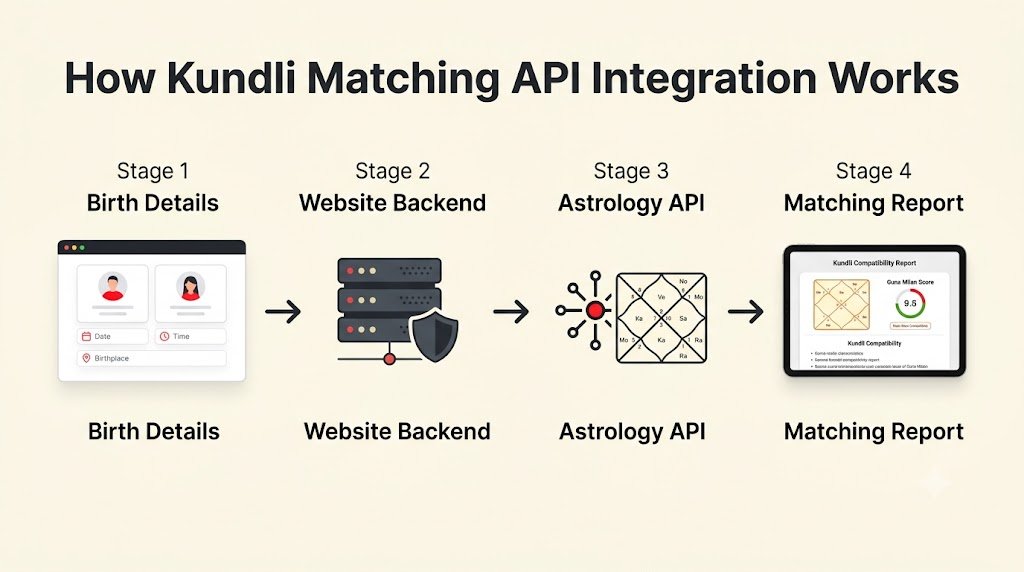
A typical integration follows this flow:
- The user enters both individuals’ birth details.
- The frontend validates required fields.
- The information is sent securely to the backend.
- The backend validates the request and communicates with the astrology API.
- The API processes the request and returns a response.
- The backend checks the response and prepares the information for display.
- The frontend presents the Kundli matching report.
The exact sequence varies by provider and implementation.
Keep API credentials on the server side. Private API keys should not be exposed in browser code or a mobile app’s publicly accessible source. The backend should also validate inputs, handle failures, and prevent unauthorised or excessive requests.
If your website already has Kundli generation or user account functionality, the new feature may be able to reuse parts of the existing system.
Step 5: Design a clear Kundli matching results page
A calculation is only part of the user experience. Visitors also need to understand what the results mean.
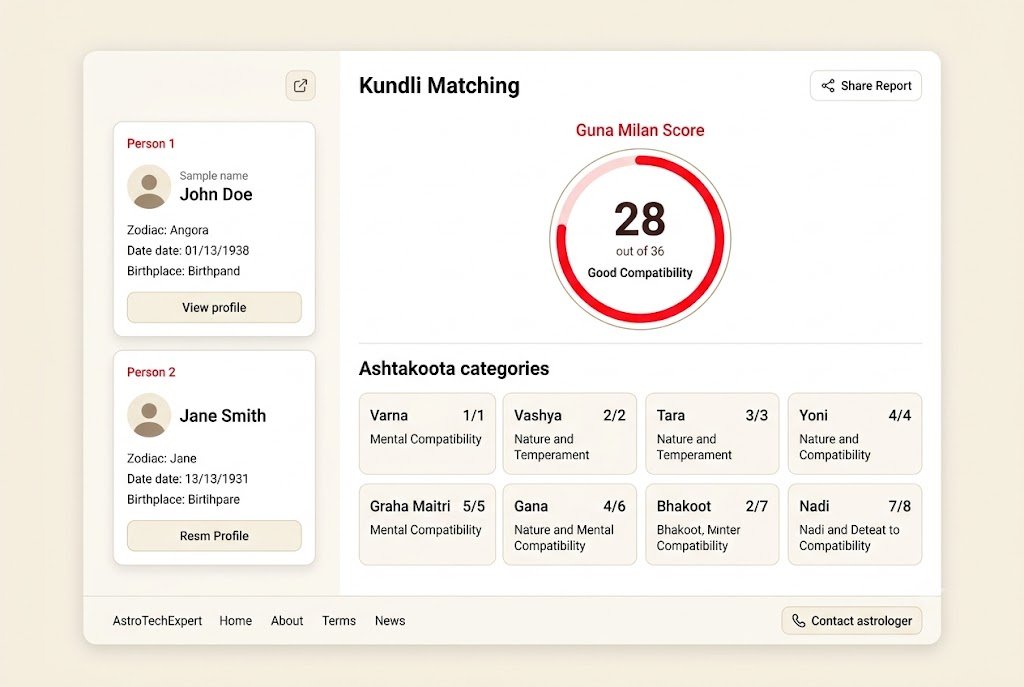
Depending on the calculation method and API response, the results page may include:
- The names or identifiers of the two individuals.
- The overall Guna Milan score, if provided.
- The maximum possible score for the selected scoring system.
- Individual Koota scores and their explanations.
- Relevant compatibility observations returned by the calculation service.
- A clear explanation of the report’s limitations.
- An option to book a consultation or access additional services.
Avoid displaying technical API responses directly to users. Convert the returned data into a readable report with clear labels and explanations.
Do not invent missing scores or interpretations when the provider returns incomplete information. If the calculation fails, show a useful error message and allow the user to try again.
Step 6: Connect the feature with existing services
Kundli matching can become more useful when it fits naturally into the rest of your astrology platform.
For example, you could connect the report with:
- Astrologer consultations: Allow users to book a session to discuss their results.
- User accounts: Let registered users access saved reports, subject to your data-retention policy.
- Payments: Charge for advanced reports or other clearly described paid services.
- Notifications: Send report-ready notifications where appropriate and with user consent.
- Multilingual content: Present supported labels and explanations in the languages your audience uses.
These additions are optional. Start with the core matching functionality and expand according to user needs.
Step 7: Launch after validation
Before making the feature available to everyone, test it with valid inputs, incomplete birth details, incorrect values, API failures, and different devices.
Check that the results match the selected provider’s documented output and that users can complete the process without confusion.
A controlled launch can help identify usability issues before the feature receives significant traffic.
Kundli Matching API vs Custom Development
The right approach depends on the complexity of the feature, available resources, and the level of control your business needs.
| Factor | API integration | Custom development |
|---|---|---|
| Calculation logic | Uses the provider’s supported calculation service | Implemented and maintained by your development team |
| Initial work | Often less calculation development, but integration is still required | Usually requires more work if the calculation system must be built from scratch |
| Customisation | Limited by the API’s supported options and response | Greater control over supported calculation logic and output |
| Maintenance | Includes API dependency, version changes, and provider management | Includes maintenance of the calculation system and supporting data |
| Ongoing costs | May include subscription or per-request charges | Includes development, maintenance, infrastructure, and any data licensing costs |
| Best suited for | Businesses whose requirements fit an available API | Projects requiring specialised functionality or greater control |
An API is not automatically the cheapest option in the long term. Usage fees, provider limitations, and future changes should be considered alongside the initial development cost.
Similarly, custom development is not automatically more accurate. Accuracy depends on the calculation method, data quality, implementation, and validation process.
Essential Features to Include
The exact feature set will depend on the purpose of your platform. These are useful requirements to consider during planning.
Accurate input handling
Validate dates, times, and birthplace information before submitting a request. Make time zones and any assumptions about missing details explicit.
Readable reports
Present the overall score, individual components, and explanations supported by the selected calculation system. Avoid overwhelming visitors with unexplained technical terms.
Responsive design
The form and results page should work on mobile phones, tablets, and desktop screens. Many visitors will access astrology services from their phones.
Secure data processing
Use HTTPS, protect API credentials, validate backend requests, and apply suitable access controls. Establish clear rules for storing and deleting birth details and reports.
Error handling
Provide helpful messages for invalid inputs, unavailable services, timeouts, and incomplete API responses. Avoid displaying internal server errors or confidential technical information.
Optional payments and consultations
If you plan to monetise the feature, clearly distinguish free and paid functionality. Explain what a paid report includes before asking users to pay.
Common Kundli Matching Integration Challenges
Several technical issues can affect the reliability and usability of a Kundli matching feature.
Inconsistent calculation methods
Different providers may use different calculation conventions or report formats. Compare their documented methods and expected outputs before switching providers or combining results.
Incorrect birth details
An incorrect date, time, or location can affect calculations that depend on those details. The interface should validate inputs and let users review their information before submitting it.
API downtime or rate limits
An external service may occasionally be unavailable or reject requests that exceed its usage limits. Implement sensible timeouts, clear error messages, and controlled retry behaviour.
Avoid automatically repeating a failed request indefinitely, especially when it may incur additional charges.
Slow report generation
Response times may depend on the provider and the surrounding application. Measure actual performance, display loading feedback, and avoid submitting duplicate requests when users click multiple times.
Data privacy concerns
Birth information and account details should not be exposed through public URLs, analytics events, application logs, or unauthorised access.
Limit collection and retention to what the feature genuinely needs, and follow applicable privacy requirements.
How to Test Kundli Matching Functionality
A reliable launch requires more than confirming that the report page loads.
Use a structured testing checklist:
- Confirm that both individuals’ required fields are validated.
- Test valid birth details, invalid dates, and missing information.
- Verify birthplace and time-zone handling.
- Compare returned scores with the selected provider’s documented examples or reference outputs.
- Check how incomplete and unexpected API responses are handled.
- Test expired credentials, rate limits, timeouts, and service failures.
- Confirm that private API credentials are not exposed to the frontend.
- Test mobile, tablet, and desktop layouts.
- Verify report saving, downloading, payment, or consultation flows if included.
- Check consent, access controls, and the handling of stored birth details.
The feature should be tested against known reference cases before release. If a provider does not offer suitable test cases, establish an agreed validation process with the development team.
How Much Does Kundli Matching Integration Cost?
There is no single cost for adding Kundli matching to an astrology website or app. The total depends on the existing platform, the calculation method, and the required features.
The main cost factors include:
API or software charges: Some providers offer free testing, while commercial use may require a subscription or usage-based payment.
Development effort: A straightforward integration into an existing website can involve less work than developing a new application or implementing a calculation system from scratch.
Design and reporting: Custom report layouts, multilingual content, downloadable PDFs, and saved report history may increase the scope.
Additional integrations: User accounts, payments, consultation bookings, and notifications require extra development and testing.
Maintenance: API changes, security updates, monitoring, and ongoing support should be included in the budget.
To estimate the cost accurately, first document the required features, confirm the API’s pricing and licensing, and assess the existing website or app. This is more useful than relying on a generic estimate that may not fit your project.
Frequently Asked Questions
1. Can I add Kundli matching to an existing astrology website?
Yes. If your website’s technology and architecture support the required integration, a developer can add Kundli matching as a new feature. The work depends on your existing system, selected calculation method, and required report format.
2. Do I need an astrology API for Kundli matching?
No. An API is one option, not a universal requirement. You can use a suitable third-party calculation service or develop a custom system. The best choice depends on your requirements, technical resources, and maintenance plans.
3. Is a Kundli matching API different from a Kundli generation API?
They can be different services or separate functions within the same API. Kundli generation generally produces birth-chart information, whereas Kundli matching compares two individuals using a supported compatibility calculation. Always verify the specific functionality offered by the provider.
4. Can Kundli matching be added to a mobile app?
Yes. A mobile app can provide a birth-details form, request the matching calculation through a secure backend, and display the returned report. API credentials should be protected rather than embedded as publicly accessible secrets in the app.
5. Can I offer free and paid Kundli matching reports?
Yes, if your calculation provider’s licence permits the intended use. You can offer a basic report and charge for additional features, detailed reporting, or consultations. Clearly explain what users receive at each price level.
6. How can I check whether a Kundli matching integration is working correctly?
Test the feature with valid and invalid inputs, compare results with documented reference outputs, and check error handling, security, mobile usability, and performance. Repeat testing whenever the API or calculation implementation changes.
7. What should I ask a developer before starting?
Ask which calculation method will be used, whether an API is required, what the integration includes, how results will be validated, how birth details will be protected, and what recurring API and maintenance charges may apply.
Conclusion
Adding Kundli matching to an astrology website or app can help businesses offer a more complete digital astrology service. The key is to choose a suitable calculation method, collect the correct birth information, integrate the service securely, and present results in a clear and useful format.
Start by defining the required functionality and evaluating whether an existing astrology API meets your needs. Then plan the interface, backend integration, testing, and ongoing maintenance before launch.
Planning an astrology website or app? AstroTechExpert helps businesses explore astrology website and mobile app development requirements, including feature planning and integrations. Visit: AstroTechExpert to discuss your project and identify an approach suited to your requirements.